
The APX method
Test first.
Train second.
Most youth training runs on feel. Ours starts with a measurement: how much force your athlete produces, how freely they move, and, with the Speed pack, how fast they accelerate and change direction. Those numbers become their training targets, and a retest shows exactly what moved. See the tests ↗
Force and movement, measured to the number, and speed with the Speed pack.
Up to three things to work on, each with a training focus, show exactly where to start.
Speed, agility, and mobility classes built around the metrics that need to move, with strength added when the athlete is ready.
Numbers update. Gaps close. Repeat.
What we train
Fast, agile, and mobile first.
Strong when they're ready.
Youth training at APX builds speed, agility, and range of motion in every class. Strength work starts with bodyweight and technique at every age; heavier load comes when an athlete's movement, growth, and age say they're ready. Every class targets a number from your athlete's report, and retests keep the training and the testing moving together.
Speed
First-step acceleration, sprint posture, and arm action. Acceleration is the speed that shows up most in youth games, so it gets the most reps.
Agility
Braking, cutting, and landing under control. Athletes learn to slow down well before they learn to turn faster, so their change of direction holds up late in a game.
Range of motion
Ankle, hip, and upper-back mobility, plus shoulder range for overhead athletes. Growing athletes lose range fast, so mobility is part of every class, not an afterthought.
Strength, when ready
Bodyweight and technique first, at every age. Load is added once an athlete moves well and controls each side. Retests show whether strength is moving.
The lab
Where they train.
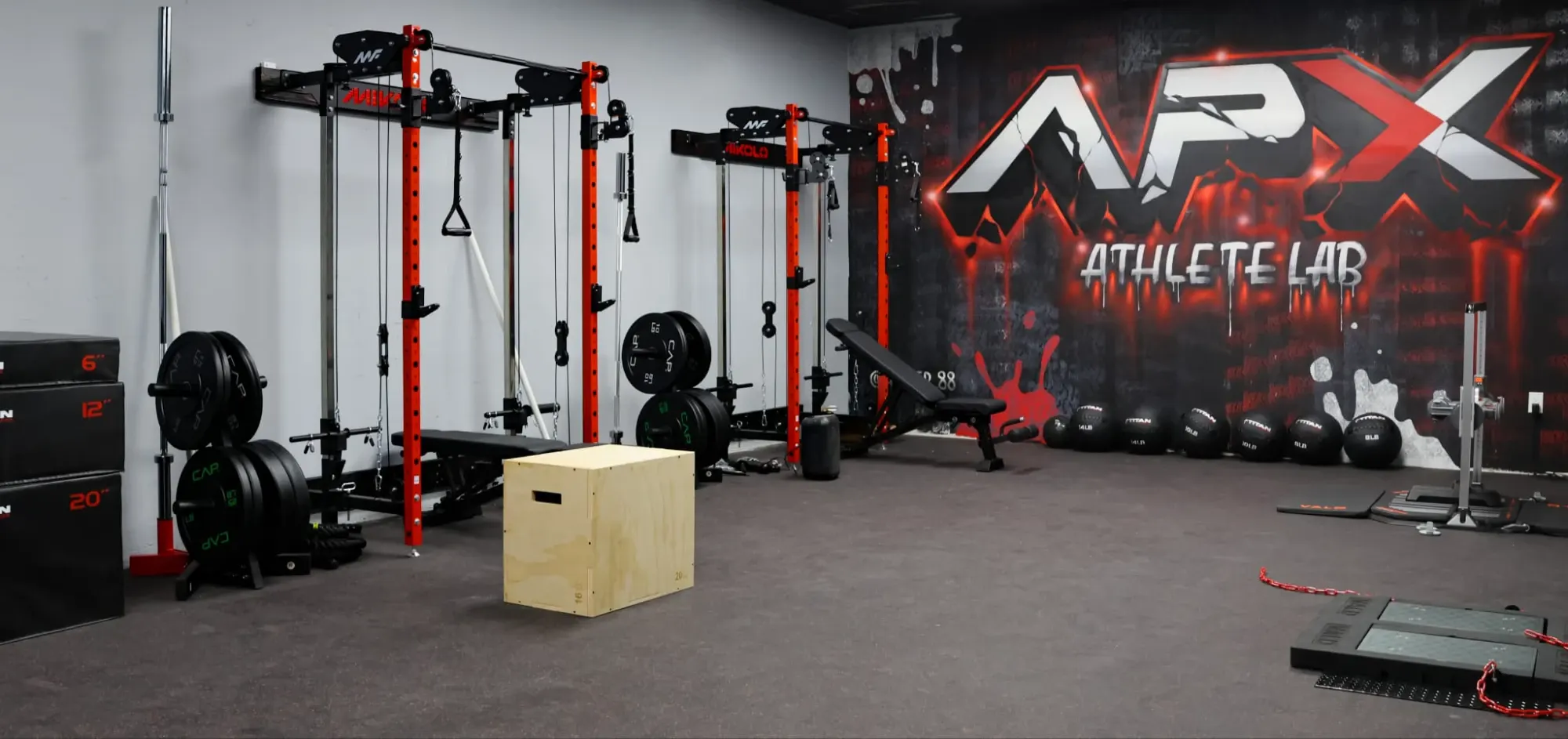
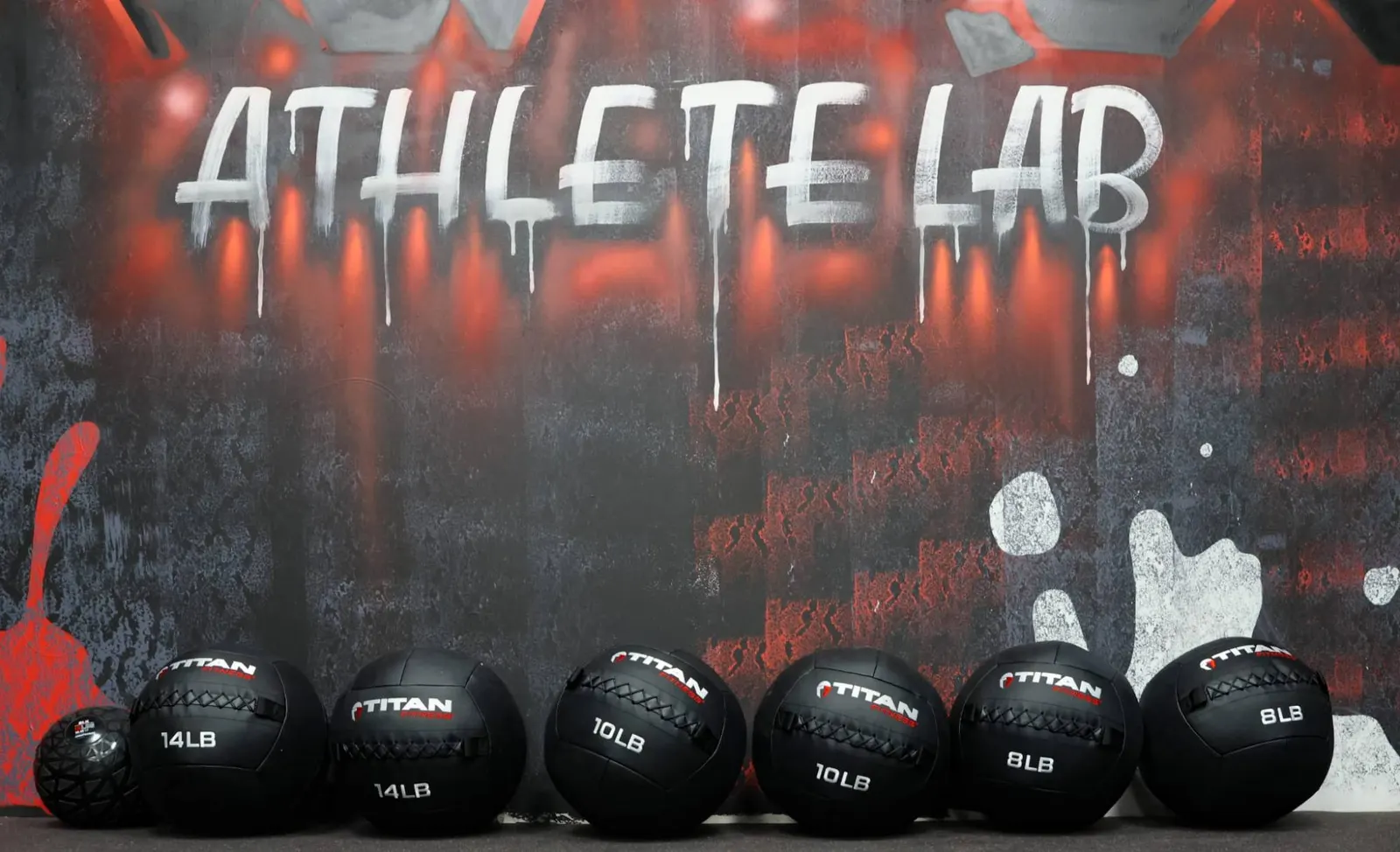
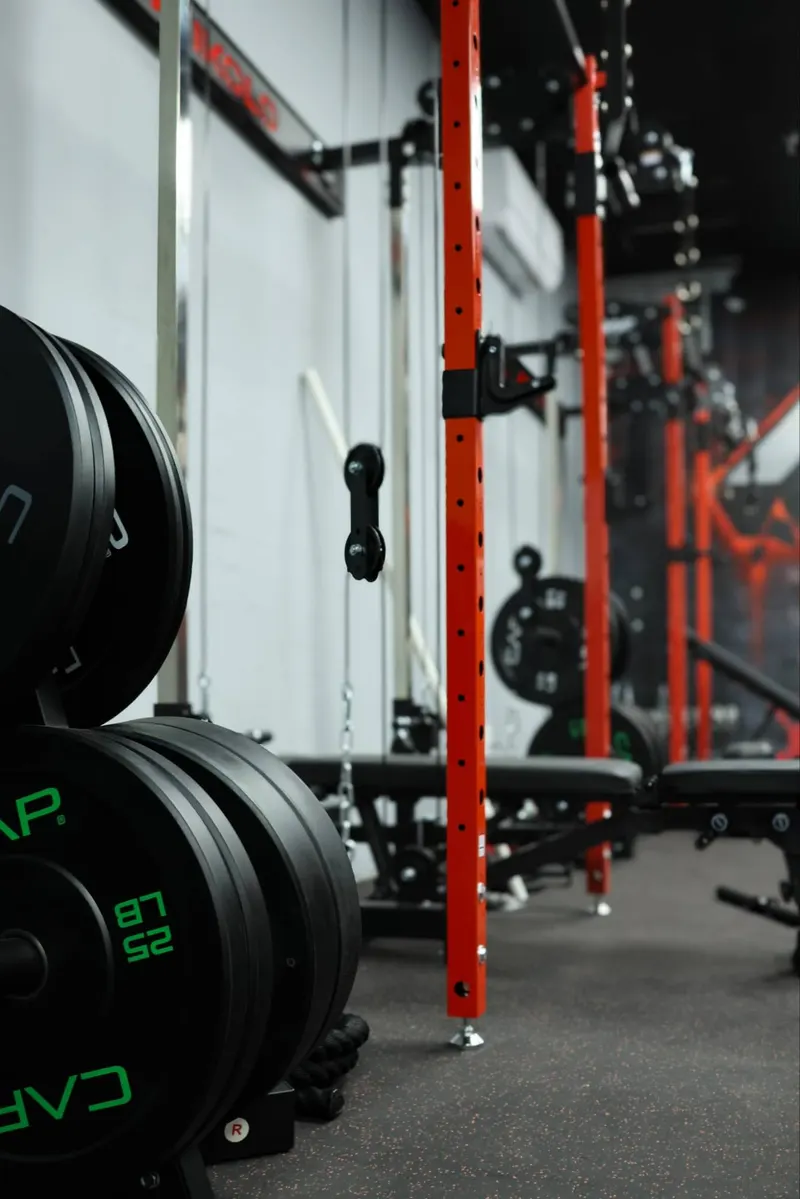
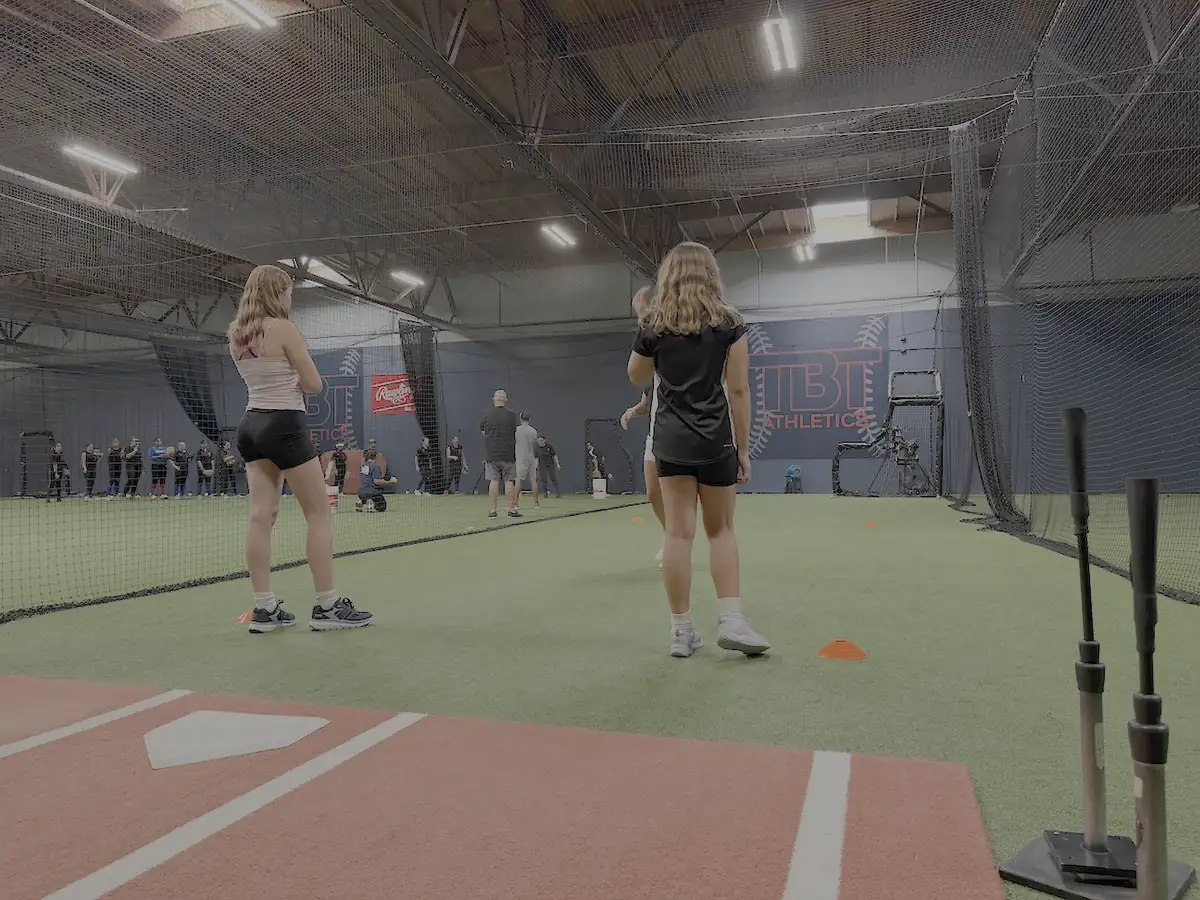
Racks, plates, boxes, and medicine balls on one floor in El Cajon, with the force plates your athlete tests on in the same room they train in.
Formats
How you train.
Speed and Agility
$399/month
Ages 8 to 14. Three 60-minute classes a week of sprint mechanics, acceleration, agility and change of direction, jumping and landing, and range of motion, grouped by ability, not age. Up to 10 athletes. A retest every month, every sport pack included.
Strength and Conditioning
$499/month
Ages 12 to 18. Two classes a week of 1 hour 45 minutes in groups of up to 8: strength and power on top of speed, moving between the turf and the lab. A retest every month, every sport pack included.
Extra class
$60 or $90 a class
Want more classes in a week? Each extra class is $60 on Speed and Agility and $90 on Strength and Conditioning, when there's a spot, with no plan change.
1-on-1
$90 a session
One coach, one athlete, 60 minutes, built around the athlete's report. Any age, adults included: adults 19 and older train in 1-on-1 sessions. On its own or on top of any plan, once your athlete has had a Baseline.
Every format is priced on one page, with no sign-up fees. Plans and pricing are subject to change. See plans and pricing ↗ See class times ↗
What we test
Numbers become workouts.
Your athlete's report doesn't sit in a folder. It drives the programming. Every Baseline runs the same tests, each one answers a specific question, and each answer maps to a training focus. Athletes under 12 run a shorter set, and nothing here is a pass or fail grade.
Countermovement jump
The most-studied jump test there is: height, power, and left-right force in one effort. How deep and how fast the athlete dips shows how they make the jump.
In training: low jump height gets plyometric loading; a slow, deep dip gets quicker, shallower jumps first, then light elastic work; a left-right force gap that holds up across tries gets single-side work.
10-5 hop
For athletes 12 and up. Ten quick hops in a row read how quickly the ankles bounce off the ground. The hops land hard, so a coach watches the practice landing first, and an athlete who can't land under control skips the test that day.
In training: a skipped or uncontrolled landing gets landing mechanics first; a slow bounce off the ground gets low, quick hops.
Hip and hamstring strength
Inner-hip and outer-hip force on each leg against fixed sensors, and hamstring force from age 12: the muscles that steady the pelvis and knee when an athlete cuts, lands, and sprints.
In training: a side gap that holds up across tries gets single-side strength; low force for body weight gets a progressive strength block once movement is clean.
Ankle test and overhead squat
3D motion capture reads ankle range as the knee drives over the toes, then depth, trunk lean, and knee alignment in the squat. The fastest way to decide what mobility or control work an athlete needs before adding load.
In training: limited depth with a forward lean gets ankle and hip mobility; knees dropping inward gets hip control.
Height and body mass are measured at every test, with sitting height for boys, to estimate where an athlete is in their growth, which sets how training is pitched; they are not scored. A drop in a number is never written off as growth: the report says when a test needs repeating instead. Test results are development tools and are never used for team selection, tryouts, or roster decisions.
Sport packs
More tests. Answers for their sport.
Sport packs ride along with every retest on a training plan at no charge, chosen by sport, up to 2 per retest. Each pack's tests slot into the session where they belong, and its results get their own section of the report and their own line in the program.
Speed
Tests: the sprint on SmartSpeed, 20 m for ages 8 to 11 and 30 m from 12, with a 10 m split for the first steps, and the 505 turn test, a sprint into a turn on each side; from age 12, calf and hip flexor strength on each side on ForceFrame.
In training: a sprint time that is not moving puts sprint technique first; speed well ahead of strength gets a strength block; a slower turning side gets change-of-direction work on that side, and a 505 well behind the 10 m split says the turn, not the speed, is the limit. Low calf or hip flexor force for body weight gets the strength behind each stride.
Overhead and Rotation
Tests: shoulder internal and external rotation strength on ForceFrame, straight-arm shoulder strength overhead on ForceDecks, and shoulder and hip rotation range on HumanTrak.
In training: a rotation-strength gap between arms that holds up across tries gets rotator-cuff work for that side; lost shoulder range gets shoulder mobility; limited hip rotation gets hip mobility; low straight-arm strength gets shoulder strength work. A throwing arm is often stronger than the other, and the report reads the gap with that in mind.
Cutting and Landing
Tests: a single-leg squat on HumanTrak, the single-leg jump on ForceDecks, and quad and glute strength on each side on ForceFrame. From age 12.
In training: a trunk that tips or a knee that drops inward on one leg gets hip and trunk work for that side; a single-leg jump gap that holds up across tries gets single-side power; a side gap in strength gets single-side strength; low quad or glute force for body weight gets the strength behind braking and cutting.
Contact and Collision
Tests: neck strength in each direction and shoulder internal and external rotation strength on ForceFrame, and the shoulder strength test on ForceDecks: lying face down, the athlete presses one straight arm into the plate overhead, at an angle, and out to the side, the positions athletes block, fend, and fall in. From age 13. An athlete also taking Overhead and Rotation runs the shoulder rotation test once.
In training: neck strength is recorded as the starting point for gradual neck strengthening, and the report starts reading it once our own data shows how; a rotation-strength gap between shoulders that holds up across tries gets rotator-cuff work for that side. The straight-arm test is new to youth athletes, so its number is tracked from test to test but not called a finding until our own repeat testing sets how big a change is real.
Get started
Training starts with a test.
Baseline Assessment $129 · Monthly Testing $99/month · No sign-up fees
Create your free family account, add your athlete, and pick a Baseline time. Questions? Call (858) 899-0098.
Create your accountSee open times · Already have an account? Sign in